Data Management Plan
WSDA’s Climate & Conservation Team
Overview
The Washington Soil Health Initiative (WaSHI) is a partnership between the Washington State Department of Agriculture (WSDA), Washington State University (WSU), and the State Conservation Commission that establishes a coordinated approach to healthy soils in Washington. Within WSDA, this work is led by the Climate & Conservation Team, which supports a growing portfolio of soil health, conservation, and climate-focused programs and projects.
This data management plan (DMP) applies to data generated and managed by the Climate & Conservation Team across multiple initiatives, including the Voluntary Stewardship Program, Saving Tomorrow’s Agriculture Resources, Nitrate Leaching Reduction, Livestock Composting, and related climate and conservation efforts.
The DMP originally was developed to support the State of the Soils Assessment (SOS), a statewide soil health monitoring program that collected nearly 1,200 soil samples and management surveys across 66 different cropping systems and all 39 counties in Washington. Following the conclusion of this effort, this DMP has been revised to support the broader range of projects led by the Climate & Conservation Team.
Chapter outline
This DMP is a living document to be continually reviewed and improved based on lessons learned, new information, and collaborator feedback.
1 What is data management? describes what data management is, why it is crucial to achieve our data-driven goals, and how our data move through the data life cycle.
2 Formats & standards describes the various data formats we collect and manage. ISO standards are also described for date and geospatial data.
3 Naming conventions describes naming conventions, best practices, and examples for how we name folders and files.
4 Organization describes how we organize our folders into a hierarchical structure.
5 Storage & version control describes where we store data, what our backup policies are, how we protect our raw data, and how we use version control.
6 Documentation describes how we record each element of the data life cycle with project-level, dataset-level, and variable-level documents such as standard operating procedures, readme files, data dictionaries, etc.
7 Data flow describes how data are generated, processed, and moved from start to finish. Processes and tasks are grouped by pre, during, and post field season.
8 Data sharing describes how we protect producer privacy; how our data fits into WaTech data categories; requirements and processes for maintaining confidentiality; and our data share agreement, public access policies, and our preferred acknowledgements.
9 Code style guide describes our recommended project structures, code-specific naming conventions, script structures, and code style.
This DMP includes many links to folders and files on the shared drive, which is only accessible to WSDA staff on the state network or remotely connected using VPN.
Google Chrome will allow you to open the links using the Enable local file links extension that should automatically be enabled by WSDA.
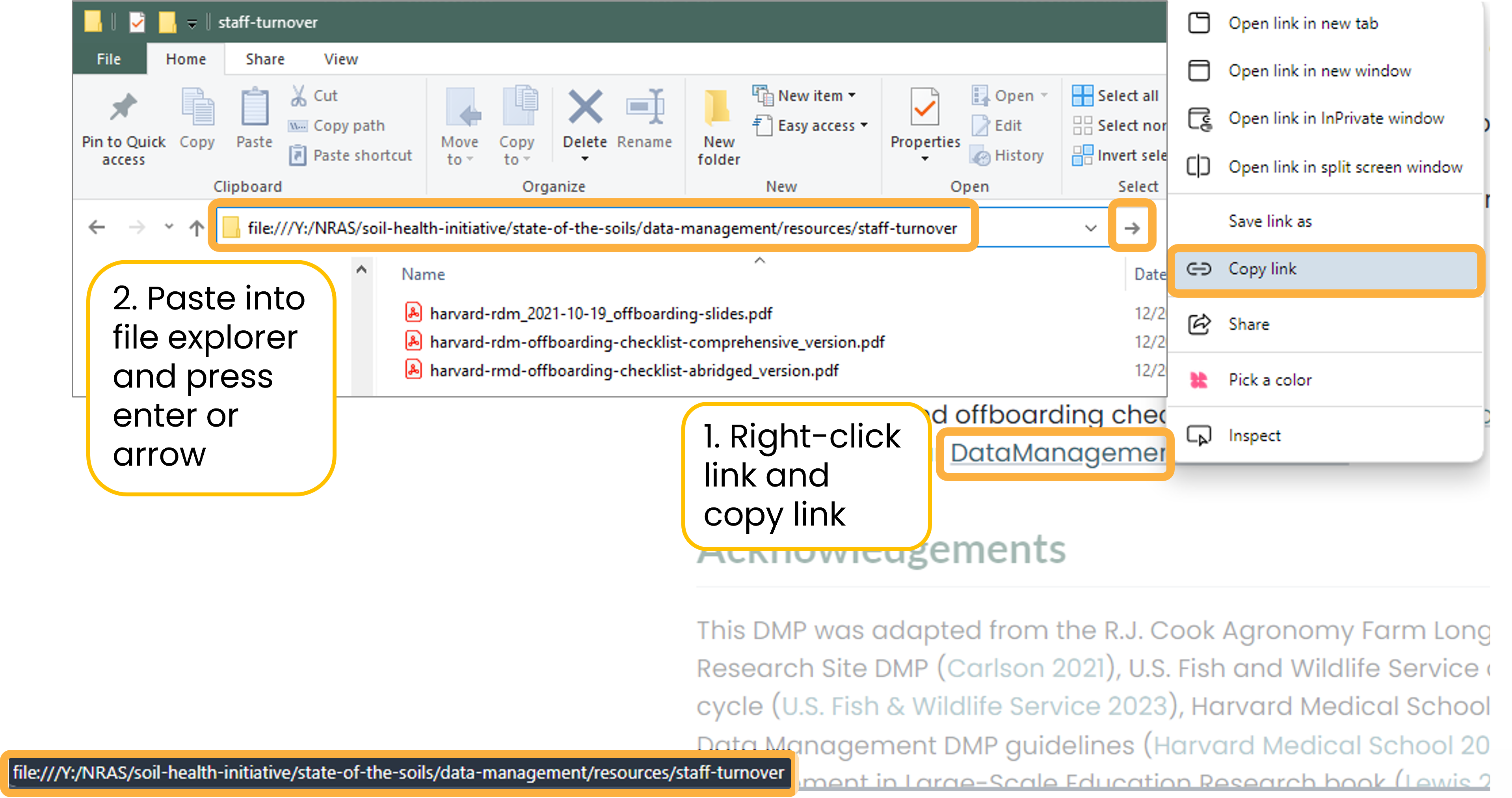
However, shared drive links are not accessible from this DMP when using Microsoft Edge. Nothing happens when clicking on these links. To open the file or folder, right-click on the hyperlink > Copy link > paste it into the search bar of the file explorer > press Enter or click the arrow.
If you are not logged into a GitHub account that is part of the WSDA organization or has access to the washi-sos repository, GitHub links to specific scripts will take you to a 404 not found error page.
Roles and responsibilities
To maximize the benefits of effective data management, all WSDA personnel who interact with Climate & Conservation Team data must familiarize themselves with this DMP.
The Data Scientist, supported by the Senior Soil Scientist, is responsible for providing guidance to staff working with data and ensuring the implementation of this DMP. The Data Scientist is also responsible for reviewing and updating this document annually, and as needed. Upon updates, the Data Scientist will distribute this document to staff and commit the source code to the GitHub repository.
Staff turnover
When staff leave, they take their skills, institutional knowledge, and personal understanding of their file management with them. Proper offboarding is essential to ensure knowledge isn’t lost, time isn’t wasted trying to recreate workflows, and projects keep moving.
Before the employee leaves, the Senior Soil Scientist and Data Scientist ensure that:
- Folders and files are moved from the employee’s personal drive to the shared drive. They are named and organized according to 3 Naming conventions.
- Workflows and specific processes the employee was responsible for are well documented.
- Permission and ownership for the following are transferred to the appropriate remaining staff:
- GitHub WSDA organization
- ArcGIS data products and online groups
- Database credentials
- Box.com folders
More resources and off boarding checklists from Harvard Research Data Management can be found in our data-management shared drive.
Acknowledgements
This DMP was adapted from the R.J. Cook Agronomy Farm Long-Term Agroecological Research Site DMP (Carlson 2021), U.S. Fish and Wildlife Service data management life cycle (U.S. Fish & Wildlife Service 2023), Harvard Medical School Longwood Research Data Management DMP guidelines (Harvard Medical School 2023), and the Data Management in Large-Scale Education Research book (Lewis 2023).